When planning a residential elevator, one of the most common questions homeowners ask is simple: Should I choose a hydraulic lift or a traction lift?
Both systems are widely used in residential buildings, villas, and small apartment blocks. Yet the cost, efficiency, and long-term performance can differ depending on the building type and usage pattern.
For homeowners in Bangalore planning a villa, duplex, or G+3 building, understanding the cost difference between hydraulic and traction elevators can help avoid unnecessary expenses and ensure the system matches the building’s design.
In this guide, we compare hydraulic and traction lifts from a cost perspective, including installation, energy use, maintenance, and long-term value.
1. Understanding the Two Elevator Technologies
Before discussing cost, it helps to understand how these two systems work.
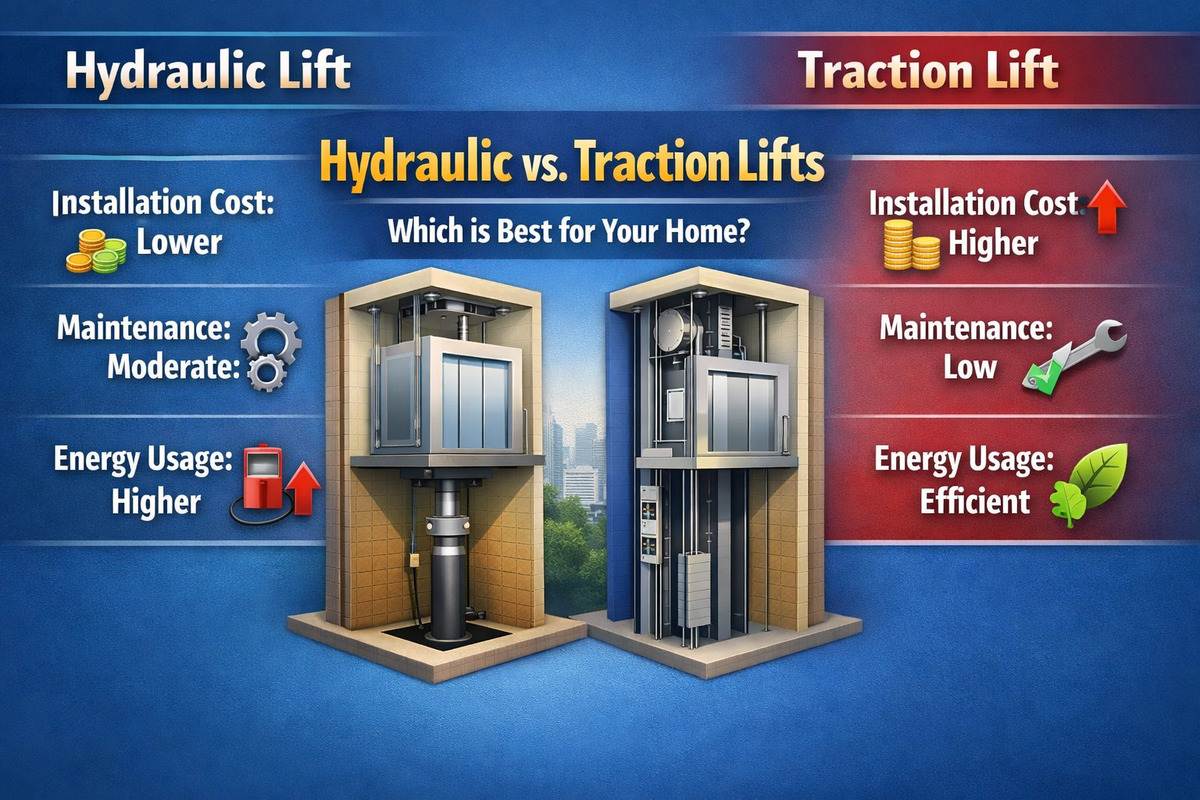
A traction elevator moves using steel ropes connected to a motor and counterweight. When the motor rotates the pulley, the counterweight balances the elevator car, allowing it to travel smoothly between floors.
Hydraulic elevators work differently. Instead of ropes, they use fluid pressure to push a piston inside a cylinder, which raises the elevator cabin. The car descends gradually when the oil is released back into the reservoir.
If you want a deeper explanation of the mechanisms behind these systems, our article “Are All Elevators Hydraulic?” explains the differences in more detail.
Both technologies are safe and widely used; the decision usually comes down to building height, usage frequency, and overall project budget.
2. Hydraulic vs Traction Lift Cost (Typical Residential Range)
For residential buildings in Bangalore, the price difference between hydraulic and traction systems is usually moderate rather than dramatic. The number of stops, cabin design, and shaft preparation often influence cost more than the drive mechanism itself.
Typical residential ranges look like this:
| Elevator Type | Typical Use | Approximate Cost Range |
| Hydraulic Lift | Villas, low-rise homes | ₹5 – ₹12 lakh |
| Traction Lift | Apartments, frequent use | ₹7 – ₹16 lakh |
These ranges reflect equipment and installation only, not shaft construction or architectural modifications.
A complete breakdown of residential lift pricing is covered in our main guide Home Elevator Cost in Bangalore – 2026 Complete Guide, which explains cost ranges by number of floors and configuration.
3. Installation Cost Comparison
Installation requirements influence the final budget significantly.
Hydraulic Lift Installation
Hydraulic lifts are often easier to install in low-rise buildings because they do not require a heavy counterweight or overhead machinery.
Typical characteristics include:
- Simpler mechanical design
- Lower structural complexity
- Suitable for compact shafts
For villas or G+2 homes, this simplicity can keep installation costs relatively controlled.
Traction Lift Installation
Traction systems require additional structural elements such as guide rails, counterweights, and a motor assembly.
However, modern machine-room-less (MRL) traction elevators reduce space requirements by placing the motor inside the shaft.
This means that although traction lifts may have a slightly higher initial price, they often provide better performance for taller buildings or higher usage.
4. Energy Consumption Differences
Operating cost is another factor many homeowners consider.
Hydraulic lifts generally consume more electricity while moving upward, because the pump must push oil against gravity.
Traction elevators are typically more energy efficient. The counterweight balances the car, meaning the motor does not carry the entire load.
In buildings with frequent elevator use — such as apartments or offices — traction systems usually result in lower long-term energy consumption.
5. Maintenance Cost Comparison
Routine maintenance is required for both systems to ensure safety and smooth operation.
Hydraulic lifts usually involve maintenance of:
- Hydraulic oil levels
- Seals and valves
- Pump system
Traction lifts require inspection of:
- Steel ropes or belts
- Pulley and motor system
- braking mechanisms
In most residential installations, annual maintenance costs fall within a similar range. In Bangalore, residential lift maintenance typically ranges between ₹25,000 and ₹60,000 per year, depending on the system type and usage frequency.
Maintenance is not just about performance — it also ensures the lift remains compliant with inspection requirements. Government authorities periodically verify elevator safety through licensed inspectors, a process explained in our article Who Inspects Elevators in India.
6. Which Lift Is Better for Your Home?
Choosing between hydraulic and traction elevators depends largely on the building’s structure.
Hydraulic elevators are ideal when
- The building is up to 3–4 floors
- Headroom space is limited
- The lift will be used mainly by a single household
- Installation simplicity is important
Traction elevators are better when
- The building has more than four floors
- Elevator usage is frequent
- Energy efficiency is a priority
- Faster travel speed is needed
In many modern projects, traction or MRL elevators are selected for apartments, while hydraulic lifts remain popular for private villas and compact homes.
7. Why the Right Lift Choice Matters Early
One common mistake homeowners make is deciding the elevator type after the building structure is complete. This can lead to expensive modifications.
Elevator planning ideally happens during the architectural design stage. This ensures:
- Proper shaft dimensions
- Correct headroom and pit depth
- Efficient electrical routing
- Lower civil construction costs
Once these structural elements are aligned early, selecting between hydraulic and traction systems becomes a straightforward engineering decision rather than a structural compromise.
8. Why the Right Lift Choice Matters Early
Compact residential lifts require preventive maintenance to ensure long-term reliability.
In Bangalore, annual maintenance typically ranges between ₹25,000 and ₹45,000 depending on system type and usage frequency.
Maintenance includes:
- Brake inspection
- Rail alignment verification
- ARD battery testing
- Door calibration
- Control system diagnostics
Electricity consumption in a typical villa installation is moderate and usually comparable to running an air-conditioning unit for limited daily usage.
Skipping maintenance may reduce short-term expenditure but increases long-term repair risk and inspection complications.
9.Final Thoughts
Both hydraulic and traction elevators serve residential buildings effectively. The cost difference between them is usually smaller than many homeowners expect.
Hydraulic lifts remain a practical choice for villas and low-rise homes due to their simpler design and compact installation. Traction elevators, on the other hand, provide greater efficiency and performance for taller buildings or projects with higher usage.
The most important factor is not just the equipment cost, but how well the elevator integrates with the building’s design and usage pattern.
At Evonic Pro Elevators Pvt. Ltd., we help homeowners, architects, and builders select the most suitable elevator technology based on structural layout, building height, and long-term usability — ensuring every installation delivers reliable vertical mobility for years to come.
10. Frequently Asked Questions