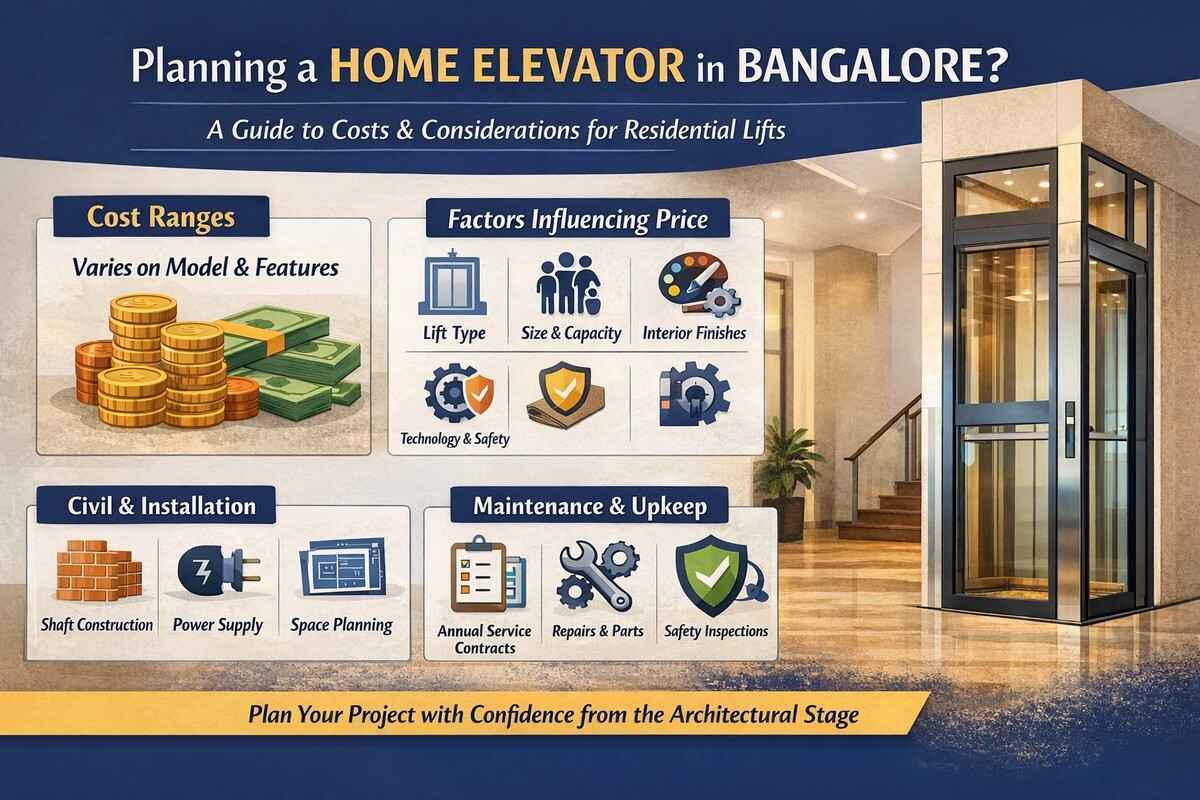
When planning a villa, duplex residence, or a mid-rise residential building in Bangalore, elevator cost is not a secondary detail — it is a structural decision that affects civil design, electrical planning, and long-term maintenance.
In 2026, a compact residential elevator in Bangalore typically starts from ₹5 lakh for a standard two-stop configuration. The final investment depends on building height, technology selection, interior specification, and site readiness.
This guide presents a structured cost breakdown based on current installation patterns in Bangalore.
Evonic Pro Elevators Pvt. Ltd. designs and installs residential and commercial lift systems across the city, and the ranges below reflect real project conditions rather than theoretical pricing.
For more about refer to About Evonic Pro Elevators
1. Entry-Level Pricing: What ₹5 Lakh Represents
A starting price of ₹5 lakh generally applies to a compact two-stop residential system designed for low-rise homes.
This configuration typically includes:
- Core lift machinery (hydraulic or compact traction depending on layout)
- Standard-finish cabin
- Automatic door system
- Controller and safety mechanisms
- Automatic Rescue Device (ARD)
- Basic installation and commissioning
It does not include shaft construction, architectural modifications, premium finishes, or generator integration.
The ₹5 lakh baseline represents a functional, safety-compliant system — not a premium aesthetic model. Pricing increases proportionately with additional structural and design requirements.
2. Cost Variation by Number of Stops
Elevator pricing scales primarily with vertical travel height. As the number of stops increases, there is a proportional rise in rail length, wiring, landing doors, and installation complexity.
In Bangalore, residential projects typically fall within the following ranges:
- Two stops (G+1): ₹5–₹6 lakh
- Three stops (G+2): ₹6–₹7 lakh
- Four stops (G+3): ₹7–₹8 lakh
- Five stops (G+4): ₹9 lakh and above
These figures represent equipment and installation only.
If the project is G+4 or above, lift provision may be influenced by approval requirements under BBMP bye-laws. It is advisable to confirm this at the drawing stage rather than after structural completion. refer to Is a Lift Mandatory for G+3 / G+4 Buildings in Bangalore?
3. Hydraulic vs Traction: Cost Impact in Residential Projects
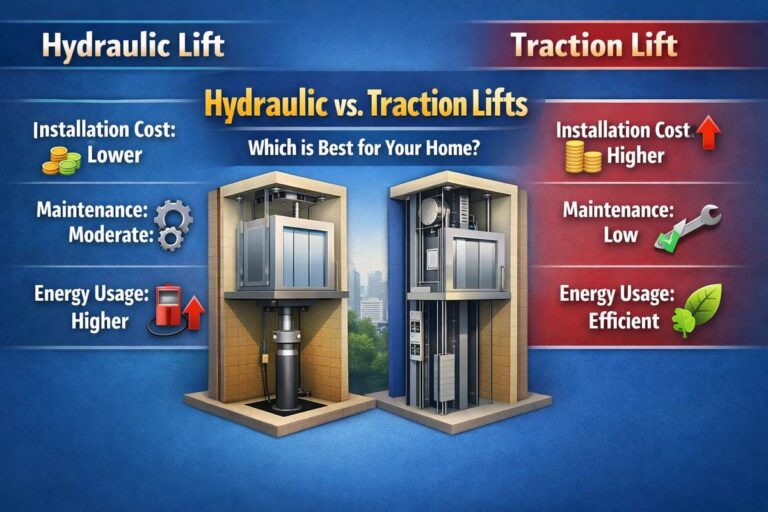
For low-rise residential buildings, both hydraulic and traction systems are viable. The cost difference between them in 2–3 stop homes is typically moderate rather than dramatic.
Hydraulic lifts are often preferred for villas and compact layouts due to simplified structural requirements. Traction or machine-room-less systems are generally selected when building height or usage frequency increases.
For a technical explanation of mechanism differences, refer to understanding hydraulic and traction lift mechanisms. From a budgeting standpoint, the decision should be based on building profile and usage pattern rather than minor upfront price variations.
4. Civil and Structural Cost Considerations
The elevator equipment itself is only part of the total investment. Shaft construction and structural preparation significantly influence overall expenditure.
In Bangalore, typical shaft construction ranges are:
- RCC shaft: ₹2.5–₹6 lakh depending on dimensions and reinforcement
- Structural steel shaft: ₹3–₹8 lakh depending on cladding and finish
Pit depth preparation, waterproofing, and alignment precision also affect cost and performance.
When lift planning is integrated into architectural drawings, civil expenditure remains controlled. When added after slab completion, structural modification costs increase substantially.
5. Primary Cost Drivers in Residential Elevators
While height sets the baseline, configuration decisions determine the final figure.
The most influential factors are:
- Number of stops
- Cabin material specification
- Door configuration (manual vs automatic sliding)
- Shaft type and dimensional constraints
- Speed selection
- Electrical readiness and backup integration
Two homes with identical floor counts can vary significantly in price due to interior specification and structural preparation.
6. Maintenance and Compliance Cost
Annual maintenance for residential elevators in Bangalore typically ranges between ₹25,000 and ₹60,000 depending on system type and usage.
Preventive maintenance includes inspection of braking systems, tension calibration, ARD battery testing, door alignment, and controller diagnostics.
It is important to distinguish routine maintenance from statutory inspection. Government-authorised inspections remain mandatory and must be kept valid under state lift regulations.
Refer to government lift inspection and certification process.
For a detailed safety overview of modern lift systems, see how residential elevators are manufactured and installed.
7. Power Backup and Emergency Systems
Modern residential elevators typically include an Automatic Rescue Device that brings the cabin to the nearest landing during a power interruption.
Generator or UPS integration is optional and depends on building classification and owner preference. For a detailed explanation of emergency power requirements and when they are mandated, refer to emergency power requirements for residential lifts
8. Frequently Asked Questions
9. Closing Perspective
Home elevator cost in Bangalore should be evaluated as part of the building’s structural and usability planning — not as a late-stage addition.
The most cost-effective projects are those where lift space, shaft design, and electrical provisions are incorporated at the architectural stage. This approach prevents redesign, reduces civil rework, and ensures smooth inspection approval.
At Evonic Pro Elevators Pvt. Ltd., residential systems begin from ₹5 lakh and are structured transparently based on configuration and site conditions.
Elevator planning is most efficient when undertaken before staircase dimensions and slab levels are finalised. Early clarity leads to predictable investment and long-term reliability.