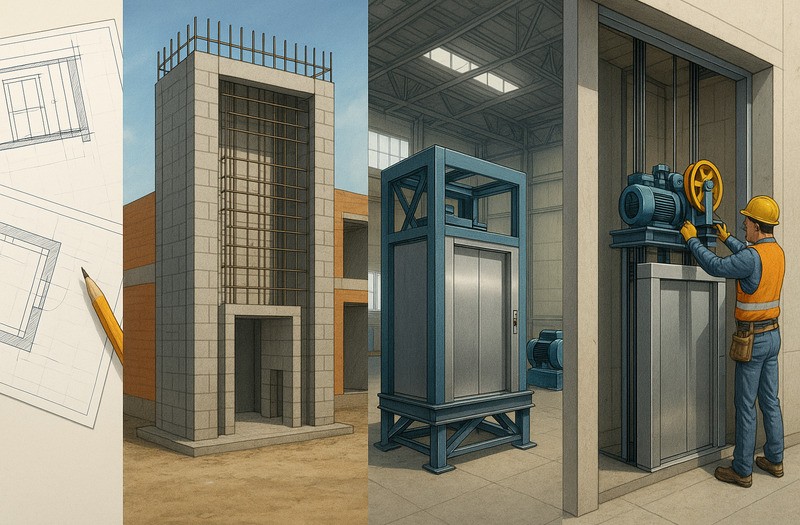
Modern elevators are an outcome of precise engineering and methodical construction. From design sketches to final certification, each stage follows a defined process where structural design, technology, and safety regulations work together. Every elevator project demands coordination among designers, manufacturers, and engineers to ensure the final system operates safely, smoothly, and in line with the highest standards of quality.
1. Design and Planning
The construction of an elevator begins much before the first component is fabricated. It starts with a detailed evaluation of the site — understanding the building’s height, the number of stops, the expected passenger load, and the available shaft space. Based on these factors, engineers determine the type of elevator that best suits the requirement.
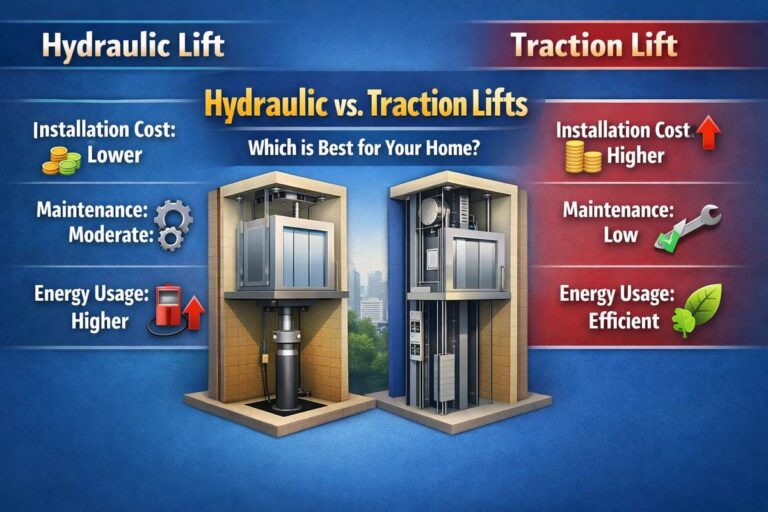
Traction elevators are generally preferred for mid- and high-rise structures, while hydraulic lifts are more suitable for low-rise buildings and private residences where compactness and cost efficiency matter. Machine-room-less (MRL) systems are a modern alternative designed to save space by integrating machinery within the shaft.
Once the type is selected, the design team calculates load capacity, travel speed, and the mechanical drive system. The planning phase also involves coordination between architects, civil engineers, and the elevator manufacturer to ensure the shaft, pit, and electrical provisions are incorporated correctly into the building plan. Every design complies with Indian regulations such as IS 14665 and the respective State Lift Acts, which specify safety, structural, and performance requirements for elevators. This detailed groundwork ensures that when installation begins, every dimension and parameter is already aligned with compliance and safety expectations.
2. Component Manufacturing and Quality Checks
After the design phase, the next stage involves manufacturing the core components that make up the elevator system. This process is carried out in specialized facilities equipped with precision tools and testing equipment. Every part is designed to meet exact tolerances because even a small dimensional deviation can affect the elevator’s balance, noise levels, and long-term performance.
The manufacturing begins with the car frame and cabin, which form the main structure of the elevator. High-strength steel sections are cut, welded, and treated to create a rigid frame that can carry both the cabin and passenger load. The cabin panels are usually made of stainless steel, aluminium, or composite materials, chosen based on the project’s requirement — hospitals may prefer stainless steel for hygiene, while residential lifts often feature glass or decorative interiors for aesthetic appeal.
Next come the guide rails and counterweights. Guide rails are milled and machined to ensure straight alignment, allowing the elevator car to move smoothly without vibration. Counterweights are assembled using steel blocks or cast iron, calibrated to balance the car’s weight precisely. This balance reduces the motor load, saving energy and improving operational efficiency.
The door assemblies are another critical component. Both the cabin doors and landing doors are manufactured with durable rollers, sensors, and mechanical interlocks that prevent accidental openings. These parts undergo repetitive open–close cycle tests to confirm their reliability over thousands of operations.
Meanwhile, the machine and drive system are prepared. For traction elevators, the motor, gearbox (if applicable), and sheaves are manufactured and dynamically balanced to reduce noise and wear. For hydraulic systems, cylinders and pistons are fabricated from precision-ground steel, and each unit is pressure-tested to detect any leakage or irregular movement.
The electrical control system — essentially the elevator’s brain — is assembled in a controlled environment. It includes the main controller, drive unit, relays, and microprocessors that coordinate signals from buttons, sensors, and safety circuits. Each control panel is programmed and bench-tested before dispatch to ensure it responds accurately to commands and safety triggers.
Before shipping, all components undergo multi-level inspections under Bureau of Indian Standards (BIS) norms, including:
- IS 14665: General construction and safety requirements for electric lifts.
- IS 15259: Specifications for hydraulic lifts.
- IS 15330: Procedures for inspection and maintenance of passenger lifts.
Manufacturers also conduct factory acceptance tests (FAT) to verify overall system compatibility — testing the motor and controller integration, door response times, and emergency stop functions. This stage acts as a pre-installation rehearsal, identifying and rectifying any potential issues well before the components reach the project site.
Through this structured process of precision fabrication and repeated quality checks, each part of the elevator system is assured of durability, safety, and compliance. By the time the equipment is shipped for installation, it is not merely a collection of parts but a pretested system ready for final assembly and calibration.
3. Site Preparation and Installation
When the equipment arrives at the project site, civil preparation is usually already underway. The construction team ensures that the elevator shaft and pit are finished according to the approved design drawings, with smooth surfaces and proper alignment. The next step is power readiness — dedicated electrical lines and control circuits must be in place for the elevator’s motor and drive system.
Installation follows a structured sequence. The guide rails are mounted first, forming the pathway for the car and counterweight. The machine unit — either a traction motor or a hydraulic pump — is then positioned in the shaft or the machine space. After that, the car frame, counterweights, and ropes (in the case of traction systems) are connected and adjusted for balance. Electrical wiring, control panels, and safety devices such as limit switches and interlocks are integrated to synchronise all components. Finally, the doors and landing mechanisms are fitted and levelled precisely with each floor.
While the process remains similar across different projects, hydraulic elevators require less overhead space and involve setting up a piston and oil reservoir instead of a rope-and-pulley arrangement. The accuracy maintained during this phase directly determines the elevator’s smoothness, sound levels, and energy efficiency. Technicians use laser alignment tools and digital calibration instruments to achieve perfect vertical movement.
4. Testing, Certification, and Maintenance
Once installation is complete, the elevator undergoes comprehensive testing before it can be used. Each system is run through multiple safety checks that simulate real-world conditions. Engineers verify the load capacity, braking performance, and levelling accuracy at every landing. They test the Automatic Rescue Device (ARD) to ensure that in case of power failure, the elevator automatically moves to the nearest floor and opens its doors safely. Door interlocks, emergency alarms, and speed governors are inspected for response precision.
These trials are documented and submitted to the relevant Lift Inspectorate for certification. Only after receiving approval from the authority does the elevator become operational. This certification process guarantees compliance with BIS standards and State Lift Acts, confirming that the installation meets all required safety norms.
Maintenance begins immediately after commissioning and continues throughout the elevator’s life. Preventive servicing includes lubricating mechanical parts, testing brake mechanisms, checking ARD batteries, and cleaning sensors. Regular inspection schedules — quarterly for home elevators and monthly for commercial units — ensure uninterrupted operation and long service life. Proper maintenance also protects warranties and keeps the system compliant with safety certifications.
(Related reading: Are Elevators Safe? Inside the Systems That Keep You Protected and Are Elevators Required to Be on Emergency Power?)
5. Maintenance and Safety Implications
Having an emergency power setup is one thing; maintaining it is another.
Backup systems, especially ARD batteries, degrade over time. Without periodic inspection, they may fail right when they’re needed most.
At Evonic Pro Elevators, our maintenance process includes:
- Quarterly Testing of ARD activation and battery charge.
- Load Simulations to ensure the elevator responds correctly during simulated power cuts.
- Battery Replacement as per manufacturer guidelines.
- Integration Checks for generators and UPS systems to verify automatic switchover timing.
We also guide building owners through compliance checks during state inspections, helping maintain valid Lift Certificates without hassle.
In India’s power-sensitive environment, where outages can happen unexpectedly, these checks ensure uninterrupted peace of mind.
Conclusion
Building an elevator is not a single task but a sequence of coordinated stages — each relying on precision, compliance, and technical expertise. The process begins with careful design and planning, extends through manufacturing and installation, and continues with long-term maintenance to preserve safety and performance.
At Evonic Pro Elevators Pvt. Ltd., we manage this process seamlessly across residential, commercial, and institutional projects. Our systems are designed and installed under strict Indian standards, ensuring reliability, comfort, and safety at every level. From blueprint to first ride, our goal remains consistent — to deliver elevators that stand for engineering integrity and dependable performance year after year.
Frequently Asked Questions