When people talk about elevators, one question often comes up — “Are all elevators hydraulic?” It’s a fair question. Most home lifts you see in villas or low-rise buildings use hydraulic systems, so it’s easy to assume every elevator works that way. But in reality, hydraulic is just one of several elevator types, each designed for specific spaces, heights, and needs.
Let’s take a closer look at how hydraulic elevators work, how they differ from traction and MRL systems, and when each type makes the most sense.
1. What Is a Hydraulic Elevator?
A hydraulic elevator works on simple fluid pressure. It uses a piston inside a cylinder, powered by hydraulic oil. When the pump pushes the oil into the cylinder, the piston moves upward and lifts the elevator car. To move down, the system releases the oil back to the tank, and gravity gently lowers the car.
This design makes hydraulic elevators smooth, quiet, and ideal for low-rise buildings — typically up to 4 or 5 floors. They don’t require a heavy counterweight or a machine room above the shaft, which makes them perfect for villas, duplex houses, and smaller commercial properties.
2. Key Components of a Hydraulic Lift
- Cylinder and Piston: The heart of the system — they handle the lift and lowering motion.
- Pump Unit: Pushes hydraulic fluid into the cylinder to move the car upward.
- Valve and Tank: Control the flow and return of oil to ensure smooth operation.
- Controller: Manages the direction, speed, and safety signals.
This simplicity makes hydraulic lifts cost-effective and easier to install compared to traction elevators.
3. Hydraulic vs. Traction Elevators
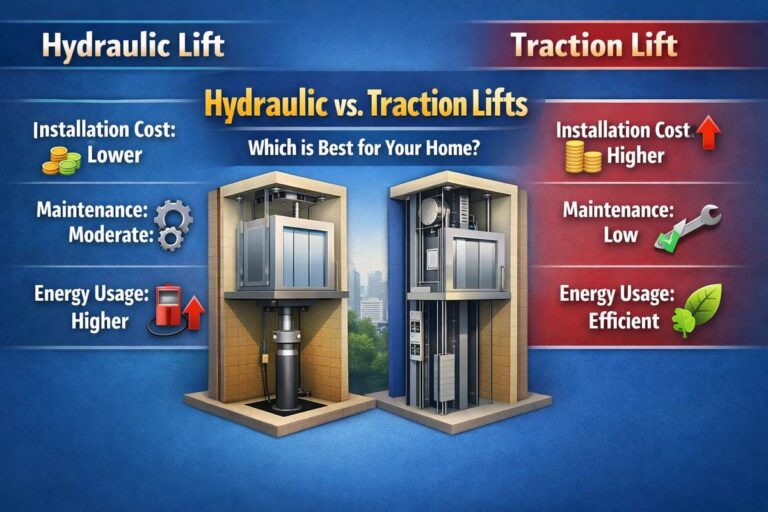
Not all elevators are hydraulic — in fact, most high-rise and commercial lifts use traction systems.
Here’s how they differ:
Hydraulic lifts win on compactness and simplicity, while traction systems are better for taller buildings where speed and efficiency matter more.
If you’d like to understand the working mechanism in more depth, check out our blog How Elevators Work: A Simple Look Inside What Moves You Every Day — it explains the balance and motor principles that drive modern lifts.
4. Advantages of Hydraulic Elevators
- Ideal for Small Buildings: No need for a deep pit or headroom.
- Smooth Ride: Hydraulic pressure offers stable and gentle movement.
- Quieter Operation: No gear or rope noise, great for homes.
- Lower Installation Cost: Fewer structural requirements reduce civil work.
5. Limitations to Consider
- Speed Restriction: Usually limited to around 0.6–1.0 m/s.
- Energy Efficiency: Uses more power when moving up.
- Oil Handling: Requires proper maintenance and occasional oil changes.
- Height Limit: Not suitable for high-rise buildings.
For these reasons, many modern projects combine hydraulic lifts for private floors or villas, and traction or MRL elevators for commercial or multi-storey complexes.
6. Machine-Room-Less (MRL) and Pneumatic Lifts — The Modern Alternatives
MRL elevators use the same traction system but fit the motor within the shaft itself. This saves space and eliminates the need for a separate machine room. They’re now popular for apartments, offices, and compact high-rises.
Pneumatic elevators, on the other hand, move using air pressure differences. They’re compact, transparent, and visually appealing — often chosen for aesthetic home interiors.
7. Which Type Is Right for You?
Choosing between hydraulic and other elevator systems depends on a few key factors:
- Building Height: Hydraulic for up to 4 floors, traction or MRL beyond that.
- Available Space: Hydraulic works best where pit and headroom are limited.
- Usage Frequency: Traction is more efficient for frequent or high-traffic use.
- Budget & Maintenance: Hydraulic lifts are cost-effective upfront, traction lifts offer long-term energy savings.
8. Safety and Maintenance
Hydraulic lifts are equipped with all standard safety features — from Automatic Rescue Devices (ARD) to door interlocks, overload sensors, and emergency valves that prevent sudden descents.
Regular maintenance is essential to keep oil levels, seals, and valves in optimal condition.
You can read more about elevator safety systems in our article Are Elevators Safe? Inside the Systems That Keep You Protected — it covers how modern safety layers and Lift Acts ensure every ride is secure.
9. Cost Comparison — Hydraulic vs Traction Elevators
While prices vary depending on design, capacity, and materials, hydraulic elevators are typically more affordable at installation. They require less civil work, making them suitable for homes and smaller buildings.
- Hydraulic Elevators: Lower initial cost, moderate maintenance, best for limited floors.
- Traction Elevators: Higher upfront investment but better energy efficiency and performance for frequent use or taller structures.
Final Thoughts
So, are all elevators hydraulic? Definitely not — but hydraulic lifts play a vital role in modern architecture. They’re compact, affordable, and ideal for private residences or low-rise structures. Traction and MRL systems, on the other hand, dominate high-rise and commercial projects.
Whether you’re planning an installation for a new home or a commercial complex, the right lift depends on your building’s design, usage, and space availability.
At Evonic Pro Elevators Pvt. Ltd., we bring the right mechanism to every project — ensuring each system, whether hydraulic, traction, or panoramic, delivers smooth rides and lasting reliability.
Because the right elevator doesn’t just move you between floors — it moves your lifestyle upward.