How Much Does It Cost to Maintain a Home Lift Per Year?
- April 24, 2026
Table of Contents
For most homeowners, the biggest question starts with installation cost. But once the lift is installed, another practical question follows: how much does it cost to maintain a home lift every year?
This is an important part of lift planning, especially for villas, duplex homes, and small residential buildings in Bangalore where owners are comparing long-term usability along with the initial purchase price.
The good part is this: a home lift is usually not as expensive to maintain as many people assume. In most residential projects, the yearly running and maintenance cost remains manageable when the lift is installed properly, used within capacity, and serviced on time.
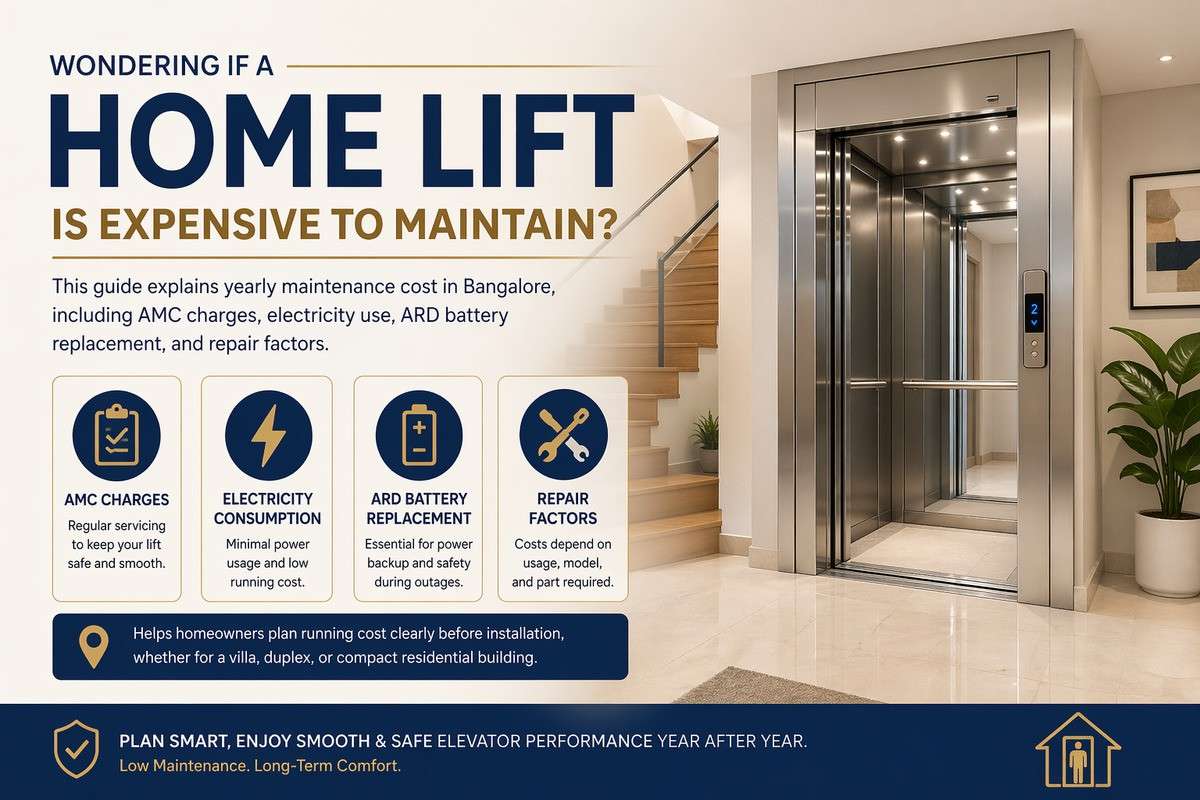
In Bangalore, the annual maintenance cost for a home lift typically falls between ₹25,000 and ₹60,000, depending on the lift type, number of stops, usage level, and service scope. That range has already been noted in the main residential pricing guide, where preventive maintenance is described as covering braking systems, ARD battery testing, door alignment, and controller diagnostics. Check out our article on Home Elevator Cost in Bangalore
This article explains what that yearly cost usually includes, what raises it, how electricity use affects your monthly expense, and whether a home lift is truly costly to maintain over the long run.
1. Why Maintenance Matters More Than Most Homeowners Expect
A lift may look simple in daily use. You press a button, the cabin moves, the doors open, and that is all most people see. But behind that smooth movement are parts that need regular inspection and adjustment: door systems, guide rails, safety circuits, ARD batteries, brakes, and the control panel.
Skipping maintenance does not always create an immediate problem. In fact, many lifts continue working for some time even when service intervals are ignored. The real issue is that neglected maintenance usually shows up later in the form of jerky movement, door misalignment, unusual sound, battery failure during a power cut, or a larger repair bill that could have been avoided with routine servicing.
That is why modern elevator systems are designed not just for installation, but for periodic maintenance throughout their operating life. The construction and commissioning process itself is built around long-term safety checks, testing, and ongoing service responsibility. See our article on Small Lift for Home Cost in Bangalore
2. What Is the Annual Maintenance Cost of a Home Lift?
For a typical residential lift in Bangalore, yearly maintenance cost usually comes under two broad categories:
1. Preventive maintenance or AMC
This is the planned servicing done at regular intervals.
2. Running and minor replacement cost
This includes electricity, battery replacement, and occasional wear-and-tear items.
For most homes, the Annual Maintenance Contract (AMC) forms the main recurring expense. In standard residential use, this often falls in the following broad range:
- Basic home lift AMC: ₹25,000 to ₹35,000 per year
- Mid-range home lift AMC: ₹35,000 to ₹45,000 per year
- Higher-spec or more frequently used home lift AMC: ₹45,000 to ₹60,000 per year
These numbers are in line with the existing cost-cluster blogs, where both the main home elevator guide and the small-home-lift guide place annual residential maintenance in the ₹25,000–₹60,000 range, with compact lifts often staying near the lower side when usage is moderate.
The actual figure depends on how detailed the AMC is and whether major parts are included or billed separately.
3. What Does a Home Lift AMC Usually Include?
A residential lift AMC is not just a routine visit to “check the machine.” A proper maintenance contract usually covers preventive inspection and service tasks that keep the lift safe, smooth, and compliant.
Typical AMC work includes:
- Brake inspection
- Door alignment and calibration
- ARD testing during power-failure simulation
- Guide rail and moving-part inspection
- Controller diagnostics
- Wiring and safety-circuit checks
- Lubrication of required mechanical parts
- General performance review for noise, levelling, and door operation
These service tasks closely match the maintenance items already described across your earlier blogs, including brake testing, ARD battery checks, door calibration, and controller diagnostics.
For home lifts, service frequency is usually lower than for commercial elevators. Your homepage FAQ draft already notes that preventive maintenance is generally recommended every three months for residential lifts, while commercial units are usually serviced monthly because of higher usage.
That difference is one reason residential maintenance cost stays relatively controlled.
4. Is Lift Electricity Consumption High?
This is one of the most common concerns homeowners have before installation. Many people assume that a home lift will add a very heavy amount to the monthly electricity bill. In most cases, that assumption is exaggerated.
For normal home use, a residential lift does not run continuously like a commercial passenger lift in an apartment or office. It only operates for short movement cycles across a limited number of floors. Because of that, the actual electricity consumption is usually moderate.
Your existing compact-lift blog already frames this well by stating that electricity use in a typical villa installation is moderate and broadly comparable to using an air-conditioning unit for limited daily usage.
The monthly electricity cost depends on:
- Number of trips per day
- Number of stops
- Lift capacity
- Hydraulic or traction mechanism
- Weight load during use
- Power quality and backup setup
A home lift used by a single family for routine movement usually consumes far less electricity than people expect. The more relevant running cost is often the AMC, not the electricity bill.
5. Hydraulic vs Traction: Which Costs More to Run?
This is where the mechanism starts to matter.
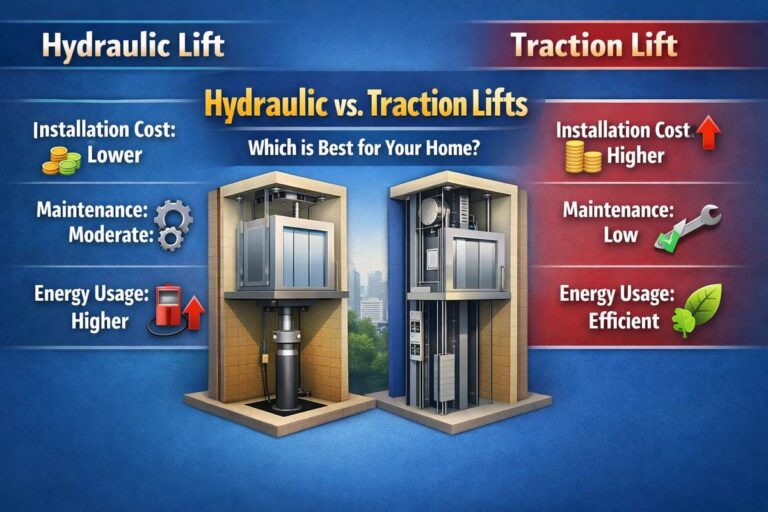
The hydraulic-vs-traction comparison already prepared in your cluster notes explains that hydraulic lifts generally consume more electricity while moving upward, because the pump has to push hydraulic oil against gravity. Traction lifts are usually more energy-efficient, because the counterweight balances the cabin and reduces the motor load. Check out Hydraulic vs Traction Lift Cost
That does not automatically mean hydraulic lifts are a bad choice. For many villas and low-rise homes, they are still a very practical option because installation can be simpler and the building may not need a more elaborate system. But from a long-term running-cost angle:
- Hydraulic lifts: often slightly higher power use
- Traction lifts: often better energy efficiency, especially with more frequent usage
For a lightly used private home, the difference may not feel dramatic every month. But if usage becomes heavier, traction systems usually make more sense from an operating-cost perspective.
This also aligns with the broader mechanism article, which explains that hydraulic lifts suit low-rise homes well, while traction and MRL systems become stronger choices when frequency, efficiency, or height requirements increase.
6. Other Yearly Costs Homeowners Should Plan For
AMC is the main expense, but it is not the only one. A realistic annual cost estimate should also leave room for a few related items.
1. ARD Battery Replacement
Most modern residential elevators include an Automatic Rescue Device (ARD) so that during a power cut, the lift moves to the nearest floor and opens the doors safely. This feature is central to modern lift safety and is discussed in detail in your emergency-power article. See if every elevator is hydraulic.
The ARD itself is not replaced every year, but its battery does not last forever. Over time, battery performance drops and replacement becomes necessary. This is not usually a monthly or annual routine cost, but it is part of ownership over the longer term.
2. Minor Parts and Wear Items
Some AMCs include selected minor consumables, while others bill them separately. Depending on the contract, owners may occasionally pay extra for small replacement items, door components, or electrical corrections that fall outside regular service.
3. Repair Cost Due to Neglected Maintenance
This is where the real expense often begins. A lift that receives routine servicing usually remains predictable. A lift that is ignored for long periods can end up with avoidable failures in door operation, levelling, emergency systems, or electrical response.
In other words, maintenance is not the expensive part. Deferred maintenance usually becomes the expensive part.
7. Is a Home Lift Expensive to Maintain?
In practical terms, no, not usually.
For a villa or duplex homeowner already making the investment in a residential elevator, the yearly maintenance burden is generally moderate. What makes it feel expensive is not the routine AMC itself, but one of these three situations:
- the lift was not planned or installed properly
- the owner skipped preventive maintenance
- the owner expected zero recurring cost after installation
A home lift is a machine with safety responsibility. So it will always have some recurring cost. But that cost is usually reasonable when viewed against the convenience it provides, especially for elderly family members, multi-generation households, and homes built vertically on compact plots.
Your small-lift blog already makes the broader value argument well: internal lifts are steadily shifting from luxury addition to practical upgrade in Bangalore’s residential market.
8. How to Keep Home Lift Maintenance Cost Under Control
The most effective way to reduce long-term expense is not bargaining for the cheapest AMC after installation. It starts much earlier.
First, the lift should be chosen according to the building’s actual usage pattern. Over-specifying the system adds cost without adding meaningful benefit. Under-specifying it can create repeated service issues later.
Second, the lift should be planned during the architectural stage wherever possible. When shaft, electrical routing, headroom, and access are properly aligned from the beginning, the lift operates better and needs fewer adjustments over time. That principle has already been emphasized in the pillar guide and the compact-lift guide.
Third, service visits should not be skipped. Residential service intervals are not as frequent as commercial ones, so they are easier to manage. But they still matter.
Finally, the owner should treat warning signs seriously. A strange sound, slower door action, jerky start, or inconsistent levelling may look minor at first, but early correction usually prevents a larger bill later.
9. Maintenance, Inspection, and Compliance Are Not the Same Thing
This distinction is important and worth making clearly in the blog.
Routine maintenance keeps the lift performing well. But statutory inspection is a separate matter. Your pillar blog already notes that government-authorised inspections remain mandatory under state lift regulations, and your lift-inspection article explains that maintenance companies cannot legally replace the role of the authorised inspector.
That means homeowners and associations should budget not just for upkeep, but for proper documentation and compliance support as well.
A well-maintained lift is easier to keep inspection-ready. That alone saves trouble, delay, and corrective expense.
10. Final Thoughts
So, how much does it cost to maintain a home lift per year?
For most residential properties in Bangalore, the practical answer is around ₹25,000 to ₹60,000 per year, with the final figure depending on lift type, number of stops, usage pattern, and service coverage.
Electricity consumption is usually moderate in-home use. Hydraulic systems may consume somewhat more power than traction systems, while traction lifts often offer better long-term efficiency where usage is higher.
The broader point is this: a home lift is not expensive to maintain when it is chosen correctly, installed properly, and serviced on time. In fact, for many homeowners, the yearly maintenance cost is a small price for the comfort, accessibility, and long-term convenience a residential lift adds to everyday life.
At Evonic Pro Elevators Pvt. Ltd., we help homeowners in Bangalore plan not just the installation cost, but the full ownership picture — including maintenance, safety systems, and long-term running practicality. Because a lift should not only fit your building on day one; it should continue serving your home smoothly year after year.