In Bangalore’s residential market, plot sizes are shrinking while vertical construction is increasing. Villas, duplex homes, and compact G+2 or G+3 residences are now common across areas like Whitefield, Sarjapur, HSR Layout, and North Bangalore layouts. As families plan for long-term usability, one question appears early in the discussion:
What is the cost of a small lift for home in Bangalore?
A compact residential elevator is not simply a scaled-down commercial lift. It is engineered specifically for limited shaft sizes, lower travel heights, and private usage patterns. The pricing reflects that specialization.
This guide explains realistic 2026 cost ranges, configuration differences, civil implications, and what truly affects the final investment.
For broader context on residential elevator pricing, refer to our main guide:
Home Elevator Cost in Bangalore – 2026 Complete Guide
1. What Qualifies as a Small Home Lift?
A “small lift” typically refers to a residential system designed for:
- 2 to 4 persons (250–400 kg capacity)
- 2 to 4 stops
- Compact shaft footprint
- Moderate daily usage
- Private residential installation
Unlike apartment passenger lifts, these systems are optimized for space efficiency and quiet performance rather than heavy traffic movement.
Most villa projects in Bangalore fall into this category.
2. Small Lift Cost in Bangalore (2026 Pricing Range)
For compact residential projects in Bangalore, entry-level configurations in 2026 typically fall within the following equipment + installation ranges:
Two stops (G+1): ₹5–₹6 lakh
Three stops (G+2): ₹6–₹7 lakh
Four stops (G+3): ₹7–₹8 lakh
These figures apply to standard compact configurations with basic cabin finish, automatic door system, controller, safety devices, and commissioning included.
They do not include premium interior customization or major structural modifications.
3. Civil and Shaft Preparation Cost
For homes where lift space is planned during the architectural stage, civil shaft preparation is usually controlled and economical.
In compact residential projects, shaft construction or structural preparation typically ranges between ₹1 lakh and ₹2 lakh, depending on:
- Whether the shaft is integrated within the staircase core
- Finishing requirements (plaster vs cladding)
- Minor reinforcement or alignment adjustments
When lift space is incorporated early in design, civil expenditure remains predictable. Structural rework after slab completion, however, may increase cost beyond this range.
4. Why Compact Does Not Mean “Low Quality”
Some homeowners assume a small lift should be dramatically cheaper than a standard elevator. That assumption is inaccurate.
Even compact systems must include:
- Automatic Rescue Device (ARD)
- Door interlock mechanisms
- Safety brakes and speed governors
- BIS-compliant control systems
- Emergency alarm integration
Inspection and compliance processes are identical regardless of cabin size.
For clarity on statutory inspection requirements, refer to:
Who Inspects Elevators? A Guide to Lift Inspection in India
The price reduction in small lifts comes from lower capacity and reduced travel height—not from compromising safety.
5. Major Factors That Influence Small Lift Pricing
While the number of stops sets the baseline, configuration choices determine the final cost.
Capacity selection plays a role. A 2-person compact cabin is more economical than a 4-person configuration.
Door type affects pricing as well. Fully automatic sliding doors increase convenience but add to the budget compared to swing doors.
Cabin finish selection is another major factor. Stainless steel panels, glass walls, designer laminates, and premium lighting elevate aesthetics but increase cost.
Structural constraints can also impact pricing. Retrofitting into an existing home often requires additional reinforcement or alignment adjustments, which add expense compared to lift planning during architectural design stage.
The earlier the lift is integrated into the building layout, the more predictable and controlled the cost becomes.
6. Retrofitting vs Planning During Construction
Many homeowners approach lift installation after completing major structural work. While retrofitting is possible, it generally increases complexity.
When lift space is allocated during architectural planning:
- Shaft dimensions remain optimal
- Staircase alignment is unaffected
- Electrical routing is cleaner
- Civil rework is avoided
Retrofitting, on the other hand, may require slab cutting, structural reinforcement, or staircase redesign. This does not make it unfeasible, but it increases budget variability.
Compact lifts are particularly suitable for retrofit projects because of their reduced shaft requirements, but early planning always offers financial advantage.
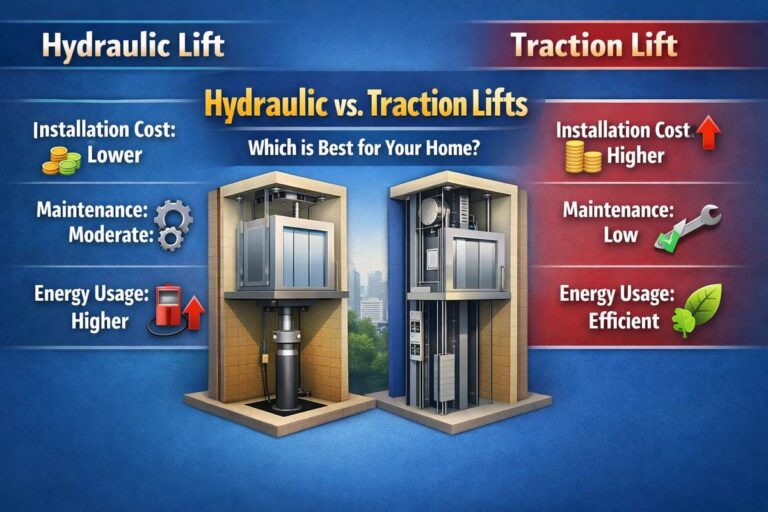
7. Hydraulic or Traction for Small Homes?
Both hydraulic and compact traction systems are used in villa installations.
Hydraulic systems are often selected where headroom is limited and simplicity is preferred.
Compact traction or machine-room-less systems are chosen when energy efficiency and slightly higher travel heights are priorities.
In 2-stop villas, cost difference between hydraulic and traction systems is usually incremental rather than dramatic. The choice should depend on building structure and usage profile.
We will explore this comparison in detail in next week’s hydraulic vs traction cost blog.
For mechanism basics, refer to:
Are All Elevators Hydraulic? A Closer Look at Lift Mechanisms
8. Annual Maintenance and Running Cost
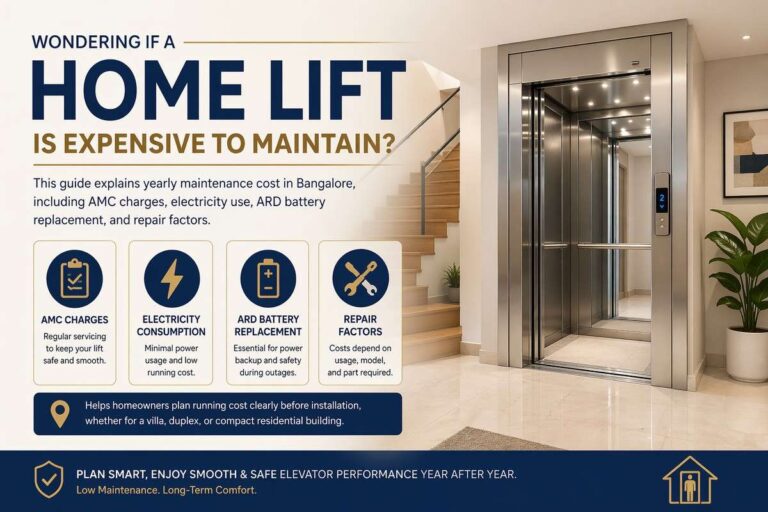
Compact residential lifts require preventive maintenance to ensure long-term reliability.
In Bangalore, annual maintenance typically ranges between ₹25,000 and ₹45,000 depending on system type and usage frequency.
Maintenance includes:
- Brake inspection
- Rail alignment verification
- ARD battery testing
- Door calibration
- Control system diagnostics
Electricity consumption in a typical villa installation is moderate and usually comparable to running an air-conditioning unit for limited daily usage.
Skipping maintenance may reduce short-term expenditure but increases long-term repair risk and inspection complications.
9. Does Installing a Small Lift Add Property Value?
In Bangalore’s residential market, compact elevators increasingly influence property perception.
For multi-generation families, lifts provide accessibility for elderly members.
For resale positioning, lift-enabled villas stand out in competitive neighborhoods.
For rental yield, especially in high-end independent homes, internal mobility is viewed as a premium convenience rather than an extravagance.
As vertical living becomes common in smaller plot developments, internal lifts are gradually shifting from luxury addition to functional upgrade.
10. Compliance and Building Category Considerations
For G+3 projects, lift provision may intersect with regulatory requirements depending on building height.
Before finalizing structural drawings, it is advisable to review local approval conditions.
You may refer to: Is a Lift Mandatory for G+3 / G+4 Buildings in Bangalore?
Understanding this early prevents redesign during sanction stage.
Final Perspective
A small lift for home in Bangalore in 2026 typically begins in the ₹6–₹10 lakh range for a 2-stop configuration, with the final figure shaped by structural readiness, cabin specification, and civil execution.
The most cost-efficient projects are those where lift planning is aligned with architecture from the outset. Late decisions increase structural complexity and cost unpredictability.
Compact residential elevators are engineered specifically for villa layouts and smaller shafts. When installed properly and maintained consistently, they provide long-term usability, convenience, and improved property positioning.
At Evonic Pro Elevators Pvt. Ltd., small home lift installations across Bangalore are designed with structural practicality, compliance clarity, and realistic cost planning at the core.