Are Elevators Required in Apartment Buildings in India?
- March 13, 2026
If you are planning, managing, or living in an apartment building, one question comes up sooner or later: are elevators mandatory, or optional?
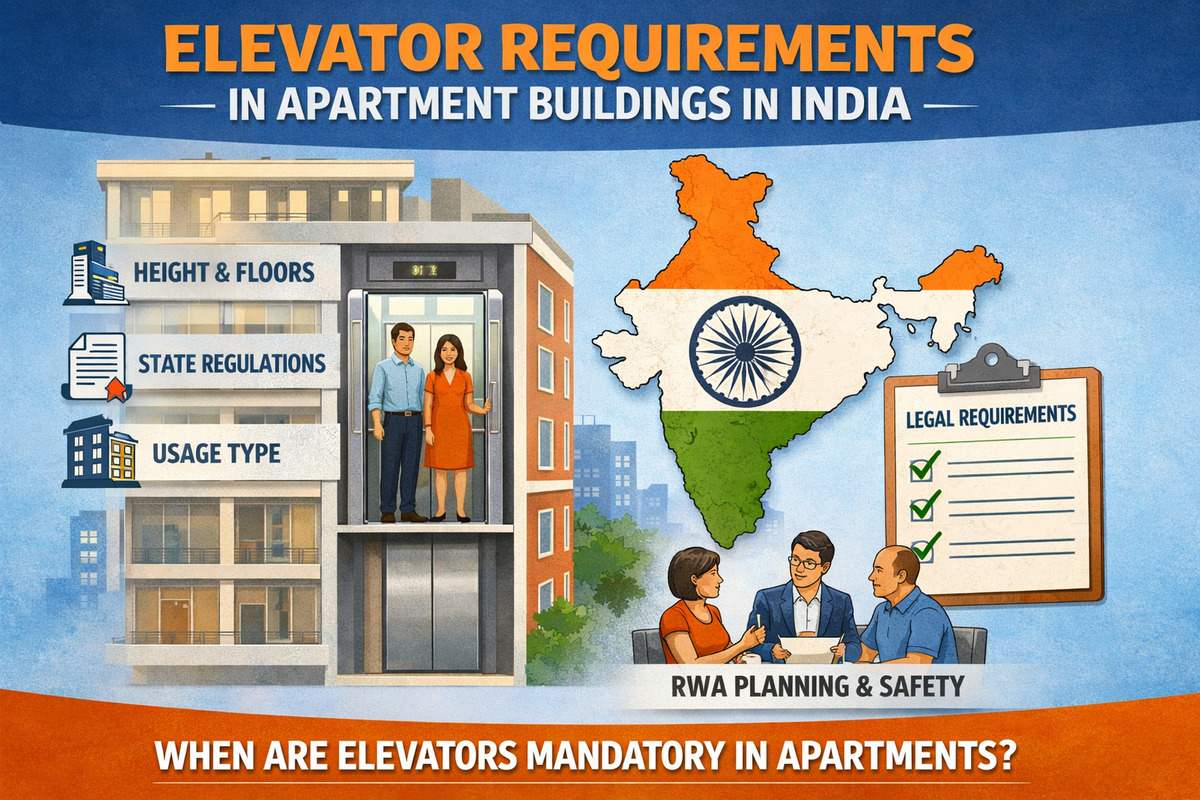
The answer is not a simple yes or no. In India, elevator requirements depend on building height, number of floors, usage type, and state-level regulations—not just convenience or budget.
This article explains when elevators are legally required in apartment buildings in India, how rules differ across states, and what apartment owners’ associations (RWAs) should plan for to remain compliant and safe.
1. Elevator Regulations in India: Who Sets the Rules?
India does not follow a single nationwide “elevator law.” Instead, elevator requirements are governed through a combination of:
- Bureau of Indian Standards (BIS) codes such as IS 14665 and IS 15259
- National Building Code (NBC) guidelines
- State-specific Lift Acts and Rules (for example, Karnataka, Maharashtra, Tamil Nadu, Delhi)
While BIS and NBC provide technical and safety frameworks, state Lift Acts carry legal authority. These Acts decide:
- Whether a lift is mandatory
- Inspection and licensing procedures
- Penalties for non-compliance
This is why two buildings with the same number of floors may face different requirements in different states.
2. When Are Elevators Mandatory in Apartment Buildings?
Across most Indian states, elevator requirements are triggered by height and floor count, not by whether the building is residential or commercial.
Common Regulatory Thresholds
Although wording differs slightly between states, most Lift Acts and building bye-laws follow these benchmarks:
- Buildings above Ground + 3 floors (G+4 and above)
- Buildings with a height of 15 metres or more
If an apartment building meets either of these conditions, a lift is generally mandatory.
This is why many G+3 buildings still end up needing a lift—because total height crosses the threshold even when floor count appears low.
3.State-Level Examples (How Rules Work in Practice)
Karnataka
Under the Karnataka Lifts, Escalators and Passenger Conveyors Act, 2012, apartment buildings that cross the prescribed height or floor limit must:
- Provide an elevator
- Obtain installation approval
- Secure operating licenses
- Renew inspection certificates periodically
This aligns closely with BBMP building bye-laws used during plan approvals.
(If you want a detailed Bangalore-specific explanation, refer to Is a Lift Mandatory for G+3 / G+4 Buildings in Bangalore?)
Maharashtra
In cities such as Mumbai and Pune, elevator provision is mandatory for:
- Residential buildings exceeding G+3 floors
- Buildings serving multiple dwelling units
Lift approval and annual certification are handled through the Electrical Inspectorate.
Tamil Nadu, Delhi, Gujarat
These states follow similar patterns:
- Mandatory lifts beyond a defined height or floor count
- Compulsory licensing and periodic inspection
- Clear penalties for operating without certification
The takeaway: apartment buildings are treated as public-use structures, even when privately owned, which increases regulatory scrutiny.
4. Are Elevators Mandatory in Small Apartment Buildings?
This is where confusion often arises.
G+2 Buildings
- Generally not mandatory
- Often optional unless special conditions apply
G+3 Buildings
- Conditional
- Mandatory if total height approaches or exceeds 15 metres
- Highly dependent on sanctioning authority interpretation
G+4 and Above
- Almost always mandatory
This is why architects and developers are advised to plan lift shafts early, even for borderline cases. Retrofitting later is costly and often disruptive.
5. Beyond Rules: Why Elevators Are Treated as Essential in Apartments
Even when technically optional, elevators are increasingly viewed as functional infrastructure, not luxury features.
Common reasons include:
- Accessibility for senior citizens and persons with mobility challenges
- Emergency movement during medical situations
- Daily usability in multi-family buildings
- Better rental and resale acceptance
Many apartment associations that initially skip elevators later struggle with retrofitting—both financially and structurally.
6. Safety, Inspection, and Compliance Responsibilities
Installing a lift is not the final step. In apartment buildings, compliance is ongoing.
Who Is Responsible?
- The building owner or apartment association (RWA)
- Not the maintenance contractor
Associations must ensure:
- Valid installation approval
- Active operating license
- Periodic inspection and renewal
Government-authorised inspectors conduct these checks, not private service providers.
(For a detailed breakdown, refer to Who Inspects Elevators? A Guide to Lift Inspection in India.)
7. Power Failures and Emergency Rescue Requirements
Most modern apartment elevators are expected to handle power outages safely.
Depending on state rules and building type, this may include:
- Automatic Rescue Devices (ARD)
- Generator or backup integration
While not every building needs full backup operation, passenger rescue during power failure is strongly expected, and inspectors routinely verify this during certification.
(This is covered in detail in Are Elevators Required to Be on Emergency Power?)
8. Common Mistakes Apartment Builders and RWAs Make
Several issues repeatedly appear during inspections and renewals:
- Assuming G+3 buildings never need lifts
- Ignoring total height during planning
- Delaying lift decisions until construction is complete
- Treating maintenance records as optional
- Letting inspection certificates lapse
These mistakes often result in:
- Approval delays
- Notices from authorities
- Temporary shutdown of elevators
Early planning and documentation discipline prevent most of these problems.
8. How Many Elevators Are Required in Apartment Buildings?
Rules vary, but factors typically considered include:
- Number of floors
- Number of dwelling units
- Expected occupancy
- Usage intensity
High-rise buildings may require multiple elevators for load distribution and emergency access. This is assessed during plan approval and inspection stages.
Final Thoughts
So, are elevators required in apartment buildings in India?
In most cases:
- Yes, when the building exceeds Ground + 3 floors or 15 metres in height
- Conditionally, for G+3 buildings depending on height and local authority interpretation
- Practically essential, even when optional, for long-term usability and compliance
Elevators in apartment buildings are no longer viewed only as convenience features. They are regulated systems tied to safety, accessibility, and legal responsibility. Understanding the rules early—before approvals, construction, or handover—saves time, cost, and compliance issues later.
For apartment owners, RWAs, and developers, the safest approach is straightforward:
plan early, follow state regulations, maintain documentation, and keep inspections current.