Is a Lift Mandatory for G+3 / 4–5 Floor Buildings in Bangalore? Rules + Practical Guidance
- March 13, 2026
If you are planning a villa, a small apartment block, a clinic, or a 4–5 floor commercial building in Bangalore, the lift question comes up early: is it mandatory, or optional?
Quick answer
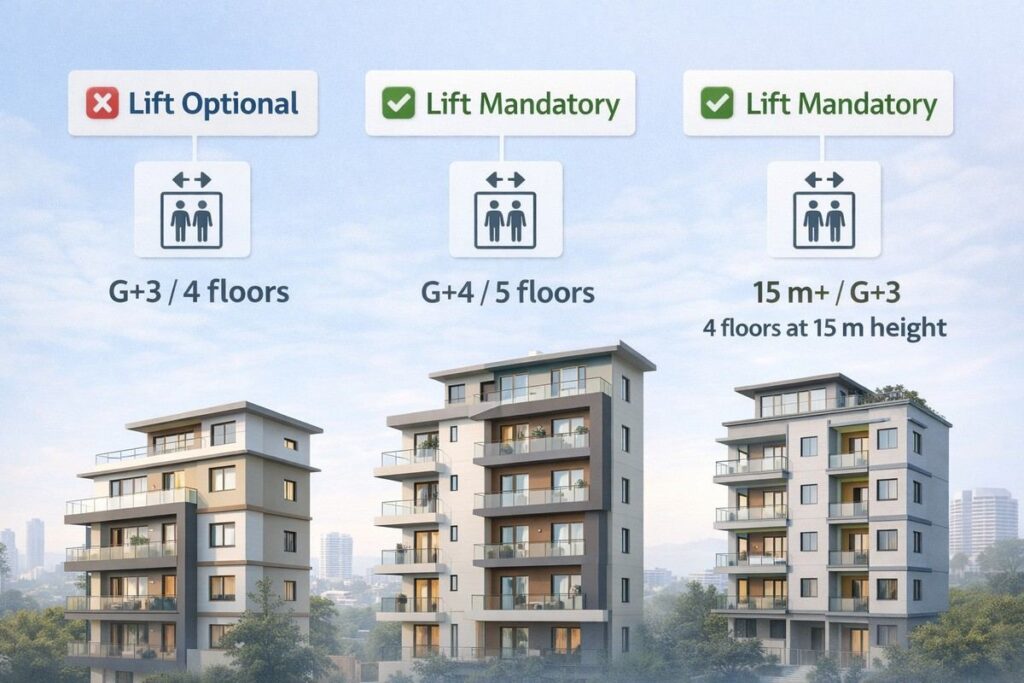
- If your building is G+4 or more: a lift is generally required.
- If your building is G+3: it depends—overall building height can still make it mandatory.
- BBMP bye-laws state lift provision for buildings 15 metres and above and/or more than Ground + 3 floors.
1. What the BBMP bye-laws say
BBMP Building Bye-Laws (2003) state that lifts must be provided for buildings with a height of 15 m and above and/or more than Ground + 3 floors (with reference to NBC provisions for lift planning and design).
That means the decision is driven by height and floor count—not only by whether the project feels “small” or “large” on site.
“Note: Approval interpretation can vary by project; confirm details with your architect and the sanctioning authority before finalising drawings”
2. What this means for G+3, G+4 and 4–5 floor buildings
If your building is G+4 / 4 floors above ground (or more), it generally falls under “more than Ground + 3 floors,” so you should plan for a lift from the drawing stage.
If your building is G+3, many owners assume “G+3 means no lift required.” That is not a safe assumption because the bye-law also applies at 15 m building height. Treat G+3 as a “measure and confirm” case—especially before civil work is finalised.
If you have stilt parking or a basement, floor counting and height measurement can become complicated in approvals. The simplest approach is to decide the lift position early and align it with the approval drawings.
3. Even when optional, many small-building owners still choose a lift
For the kind of projects Evonic Pro typically serves—villas, compact apartments, clinics, and small commercial blocks—the lift decision is often driven by comfort and usability, not only rules. Common reasons include easier access for seniors, better convenience for daily movement, improved rental preference, and smoother patient movement for clinics.
4. Common mistakes that increase cost later (and how to avoid them)
Many lift-related cost overruns in Bangalore happen because the lift decision is taken too late. Owners finalise the staircase and structure first, and then try to “fit” a shaft into leftover space. This often forces compromises in cabin size, door opening, and landing entry layout—and sometimes leads to civil rework. Planning the lift along with the staircase at the approval stage keeps the shaft clean, usable, and aligned with the building’s daily movement needs.
Another frequent issue is treating power and finishing as minor details. Lifts need stable electrical provision and a clear passenger-rescue plan for outages, and late-stage flooring or entrance changes can affect door setting and levelling. These problems are avoidable when landing levels, entry width, and rescue arrangement are discussed early with the lift provider and then kept consistent through the finishing stage.
With these basics in place, compliance and periodic inspections become much simpler—because the lift is installed as per plan, maintained properly, and supported with the right documentation.
5. Inspections and compliance in Karnataka
A lift is a regulated system. Owners and RWAs should keep installation and testing documents organised, keep maintenance records updated, and plan periodical inspection/renewal on time.
Related reading (internal): Who Inspects Elevators? A Guide to Lift Inspection in India
6. Power cuts: plan a rescue solution
Power cuts and voltage fluctuations are practical realities. Even if you do not plan full backup running, a passenger rescue setup is strongly recommended so occupants are not stuck inside the cabin.
Related reading (internal): Are Elevators Required to Be on Emergency Power? Find Out
7. A quick safety note
Industry safety research on elevator- and escalator-related fatalities shows that many severe incidents involve work around shafts and equipment during construction, maintenance, and inspection. This is primarily a worksite safety issue; for building owners, the practical focus is straightforward—choose a competent installer, follow scheduled maintenance, and keep documentation updated for statutory checks.
Frequently Asked Questions
In most cases, yes. As per BBMP bye-laws, lift provision applies to buildings with more than Ground + 3 floors and/or a height of 15 m and above. Since G+4 is more than Ground + 3 floors, you should plan the lift from the drawing stage.
Not automatically. BBMP bye-laws also apply at 15 m building height, so a G+3 project may still need a lift if the overall height reaches that level. If your project is close to the limit, decide early to avoid late-stage civil changes.
Many apartment buildings are covered by the same BBMP condition: 15 m and above and/or more than Ground + 3 floors. So the requirement depends on the building’s height and number of floors.
Traffic does not remove the requirement if your building crosses the BBMP thresholds. Even beyond rules, lifts are commonly chosen for easier access for seniors and stronger rental preference.
It can affect how floors and height are treated in approvals. Plan the lift shaft early and align it with the approved drawing set to avoid redesign later.
The building owner or association is responsible for approvals, renewals, and inspection readiness. The maintenance provider supports with servicing and records, but compliance cannot be treated as “their responsibility only.”
Even if full backup running is not planned, a rescue arrangement (such as ARD) is recommended so passengers can exit safely during outages.